

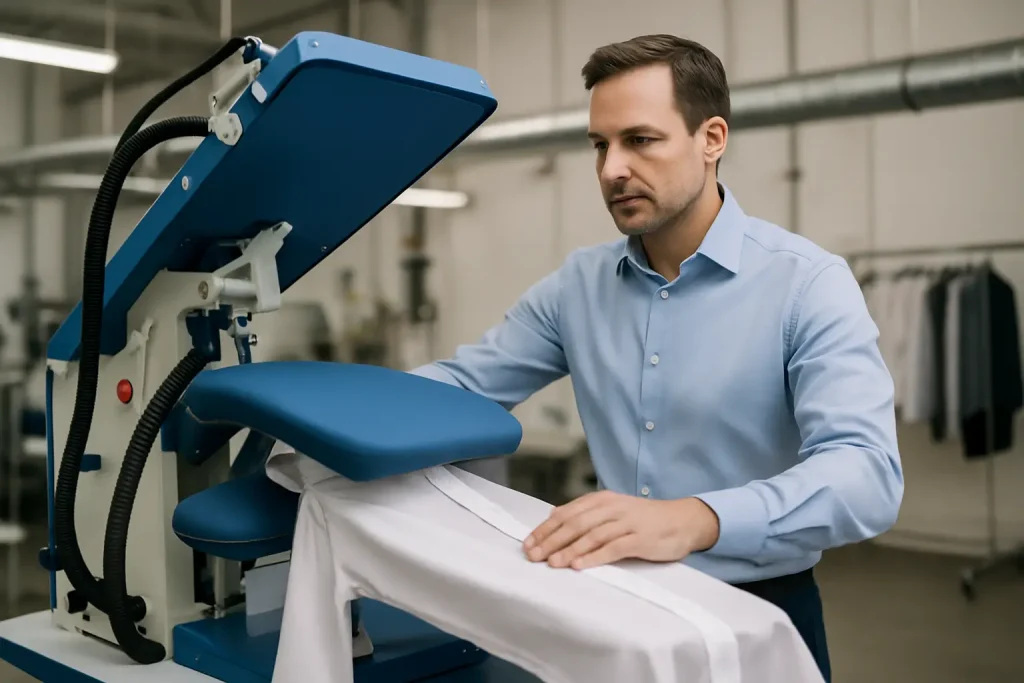
If your finishing area is where good work turns into great work, you already know the real cost of inconsistency. One operator gets crisp collars all day. The next shift fights shine marks, soft creases, and rework that eats your throughput. That is exactly where Rotondi tends to show up in the conversation – not as a “nice to have,” but as a practical way to standardize results when you are pressing garments for paying customers.
Rotondi is widely recognized in the professional pressing and finishing space. For commercial laundry and dry-cleaning decision-makers, the question is not whether pressing matters. It is whether your current setup is giving you repeatable quality, predictable cycle times, and equipment that your team can actually live with day after day.
What “rotondi” usually means on a quote
Rotondi is typically associated with professional finishing equipment: presses, form finishers, steam-air systems, spotting/finishing stations, and the kinds of specialty solutions you see in serious dry-cleaning and shirt operations. In plain terms, it is the gear that takes cleaned textiles and turns them into deliverable product.
That matters because finishing is often the bottleneck you do not notice until you are busy. Wash and dry capacity can be expanded with another machine. Finishing, by contrast, depends on trained labor, station layout, and equipment consistency. When demand spikes, pressing and finishing are where promised turnaround times either hold or collapse.
Where Rotondi fits best: choosing it for the right operation
Not every facility needs the same level of finishing investment. Rotondi makes the most sense when the value of appearance is high and when you need repeatable outcomes across multiple operators.
For a dry cleaner that lives on shirts, uniforms, and customer-facing garments, finishing is your product. A strong finishing setup pays back in fewer redos and fewer customer complaints, and it helps your team hit a consistent “house standard” regardless of who is running the station.
For hotels and on-premise laundries, it depends. If most volume is towels and flatwork, you may prioritize washing, drying, and ironer/feeder lines. But if your property handles guest laundry, staff uniforms, or high-visibility items, the finishing area becomes a brand-protection function. Wrinkles and soft creases are not just cosmetic – they can read as poor hygiene or poor control.
For healthcare and linen services, the driver is often presentation plus compliance. Uniforms, lab coats, and certain presentation textiles need consistent finishing that does not introduce damage or contamination risks. Here the best fit is equipment that is easy to operate, easy to keep clean, and reliable under continuous use.
The operational case: quality, speed, and labor stability
When buyers ask whether a finishing line is “worth it,” what they are really asking is whether it reduces the two biggest drains in finishing: labor variability and rework.
A well-chosen Rotondi pressing or finishing solution can improve consistency because the process is less dependent on an operator’s personal technique. Better control of steam, air, pressure, and dwell time reduces the range of outcomes. That is important if you are managing turnover, training new staff, or scaling production quickly.
Speed matters too, but it is not just cycle time. It is the entire flow: staging garments, pressing, touch-ups, cooling, and packing. If a new press saves 15 seconds per garment but creates a queue because the station is awkward to load or the buck shape does not match your garment mix, you will not feel the gain. Finishing equipment needs to match what you actually process most days, not what you process on your best day.
The third factor is labor stability. High-skill pressing is hard to hire and harder to retain. Equipment that standardizes output reduces your dependence on a single “star presser” and makes training more predictable. That is not a soft benefit. It is an uptime and revenue benefit.
The trade-offs buyers should be honest about
Rotondi is not a magic wand. Like any professional finishing solution, it comes with practical trade-offs.
First, you may be moving cost from labor to equipment. If you currently rely on highly skilled pressers to get premium results on basic stations, upgrading can lower skill dependency but raises capital investment. The right move depends on your labor market and your volume stability.
Second, finishing equipment is sensitive to utilities and maintenance habits. Steam quality, air supply, filtration, and condensate management affect performance. If your boiler and air systems are neglected, even excellent finishing equipment will produce inconsistent outcomes.
Third, layout matters. Pressing stations need ergonomic space, safe steam routing, and a flow that avoids backtracking. If you bolt new equipment into a cramped corner, you will not get the result you paid for.
How to evaluate Rotondi for your garment mix
Most finishing mistakes happen because buyers choose based on brand name or a single demo garment. You want to choose based on your top-volume items and your highest-risk items.
Start with your mix: shirts, pants, jackets, uniforms, delicate fabrics, heavy workwear, hospitality garments. Then identify what drives customer complaints or rework today. Is it collar and cuff sharpness? Seam impressions? Shine on dark fabrics? Inconsistent creases?
From there, think in production terms. If your line is shirt-heavy, you care about repeatable collar/cuff finishing and consistent body presentation. If you are uniform-heavy, you care about durability under continuous cycling and forgiving operation across different fabric weights.
Finally, consider your peak hour. If you need to push volume in short windows, you want equipment that keeps temperature and pressure stable under load, not just at startup.
Consumables and small parts: the quiet factor in finishing uptime
Finishing equipment is only as reliable as the basics around it. In real operations, downtime is often caused by small items: worn pads and covers, minor air leaks, tape and identification failures, or a lack of the right needles, fasteners, or marking tools that keep workflow organized.
That is why procurement for finishing should not be split into “big equipment now” and “small supplies later.” Later becomes emergency purchasing, and emergency purchasing is almost always more expensive and slower.
If you run multiple customer accounts, identification is a finishing issue too. Mis-sorted garments and missing identification create rework that lands right back at pressing and packing. Keeping marking tapes, laundry pens, and related accessories stocked is a straightforward way to protect finishing flow.
Planning the install: what to confirm before you buy
Pressing equipment decisions go better when you confirm the site realities upfront.
Utilities are first. Confirm steam capacity and quality, air capacity and dryness, electrical specs, and condensate routing. If the utilities are marginal, you may need to fix infrastructure before you judge the equipment.
Operator workflow is second. Where will garments stage? Where will hangers go? How will finished goods cool before bagging? If the station forces operators to twist, reach, or step around obstacles, you will pay for it in fatigue and slower output.
Serviceability is third. Ask what routine maintenance looks like and how often wear items typically need replacement. Finishing equipment lives in the real world: lint, heat, constant cycling. You want a plan that keeps performance steady, not a plan that reacts after quality drops.
When Rotondi is the wrong answer
Sometimes the right decision is to fix fundamentals before adding premium finishing.
If washers and dryers are your constraint, finishing upgrades may not move the needle. If garments are coming out overly damp or overheated because drying is inconsistent, pressing quality will vary no matter what you install. If your operation is mostly linens and you rarely press garments, your best return may be in wash-extract capacity, dryer efficiency, or workflow layout.
And if your team does not have the supervision bandwidth to enforce process, investing in high-performance finishing without training and standards can disappoint. Equipment improves results when the operation is ready to use it correctly.
Sourcing: keep finishing procurement simple
Commercial laundry buyers do not have time to chase ten vendors for one working line. The most practical approach is to consolidate where you can: equipment, consumables, and the day-to-day parts that prevent small stoppages.
That is the reason operators work with specialized suppliers who understand production environments and compatibility questions. If you want a single place to discuss commercial laundry equipment and the recurring supplies that keep production moving, ABELCO EQUIPMENT TRADING LLC is specialized in the laundry and dry-cleaning equipment industry at https://Www.abelco.me.
The best finishing setups are not the fanciest. They are the ones that produce the same result at 9 a.m. and 9 p.m., with minimal rework and no drama when your best presser is off that day.