

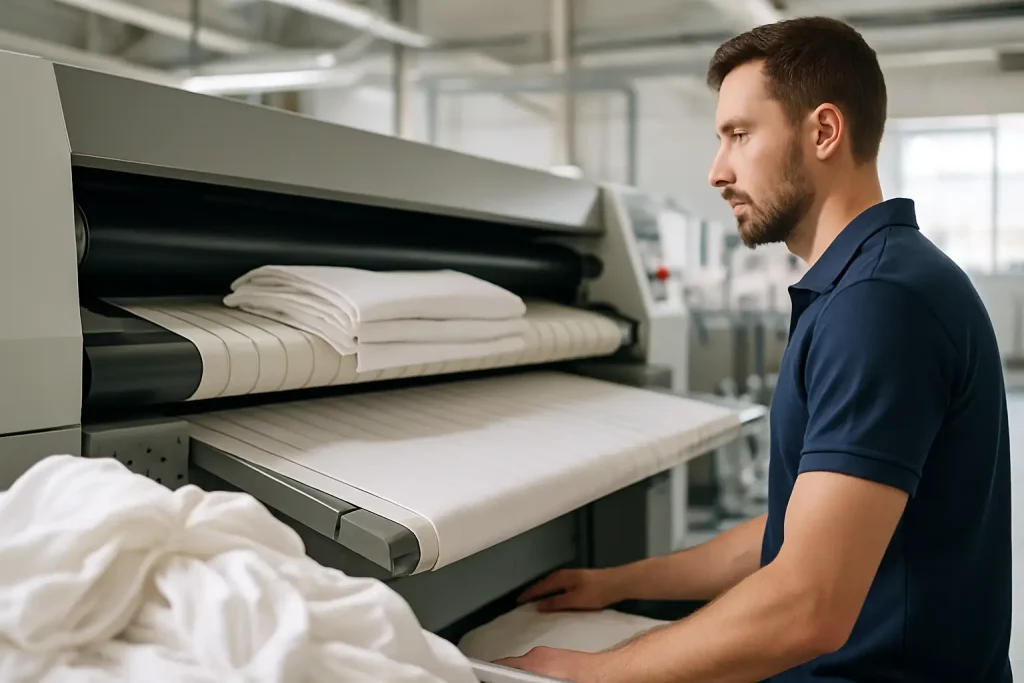
If your team is spending hours chasing wrinkles in sheets and table linen, you do not have a “finishing” problem – you have a throughput problem. A flatwork ironer is one of the few pieces of laundry equipment that can change both the look of your product and the number of pounds you can ship in a shift. But it only pays off when it is sized to your workflow, your linen mix, and your staffing reality.
What a flatwork ironer actually does (and why it matters)
A flatwork ironer is built to dry and finish flat linen in one pass by running it over a heated surface under pressure. In practical terms, it turns damp, well-extracted sheets into smooth, guest-ready linen at a pace no hand ironing or small press can match.
The biggest operational benefit is consistency. When the machine is running correctly, the finish is repeatable across operators and shifts. That reduces rework, customer complaints, and the hidden cost of “touch-up” time that never shows up on a purchase order.
Where flatwork ironers fit best
Flatwork ironers earn their keep anywhere you process volume in flat linen: hospitality, healthcare, institutional housing, and any commercial plant doing sheets, duvet covers, pillowcases, and banquet linen. They also make sense for dry cleaners who handle high-end table linen or do contract work for restaurants – but only if the volume is steady enough to justify dedicating floor space and labor.
If your mix is mostly garments, an ironer can still help, but the business case is usually weaker unless you are routinely finishing a lot of flat items. A machine that sits idle is not “capacity.” It is overhead.
The decision points that determine performance
Buying a flatwork ironer is not about finding the biggest roller. It is about matching the machine to moisture levels, fabric types, production targets, and operator skill.
Roller diameter and working width
Working width determines what you can feed without folding or double handling. If you process king sheets or wide banquet linen, you want enough width to run them efficiently. Roller diameter impacts dwell time and finishing quality. Larger diameters generally give better results at higher speeds because linen stays in contact with heat longer.
The trade-off is footprint and capital cost. A wider, larger-diameter unit demands more space and usually more power. If you are tight on floor space or utilities, you may get a better return from a slightly smaller unit that runs all day than a large unit you cannot fully utilize.
Heating type: electric, gas, or thermal oil
Heating is where operating cost and infrastructure meet.
Electric heating is simple to install in many facilities but can be expensive to run depending on your rate structure and demand charges. Gas heating can be cost-effective for high-volume operations, but it requires proper venting and gas supply. Thermal oil systems are common in higher-capacity ironers and can deliver stable heat, but they add complexity and maintenance considerations.
There is no universal “best.” The right choice depends on your utility pricing, local installation constraints, and whether you need fast heat-up times between shifts.
Chest-heated vs roller-heated designs
Many commercial ironers use a heated chest for efficient heat transfer and consistent finish quality. Roller-heated designs exist in some configurations, but the typical question you should ask is straightforward: what finish standard are you selling, and how fast do you need to get there? Consistent chest heat often supports higher, more predictable output when your linen is properly extracted.
Feeding method: manual, assisted, or full line
A flatwork ironer can be a standalone machine or the center of a finishing line with feeders and folders/stackers.
Manual feeding can work for smaller operations, but it becomes labor-limited quickly. Assisted feeding increases consistency and reduces operator fatigue, which directly impacts throughput late in the day. Full lines are a different level – they reduce labor per piece and tighten quality, but they demand higher volume to justify the investment.
Your labor market matters. If turnover is high, systems that simplify training and reduce operator dependency can pay back faster than you expect.
The hidden variable: extraction quality
Ironers do not like water. If linen comes out too wet, you lose speed, you lose finish, and you stress components.
A common performance gap is upstream: washers and washer-extractors that do not hit consistent G-force, or operators changing formulas and leaving too much retained moisture. When moisture is controlled, the ironer becomes predictable. When it is not, the ironer becomes a bottleneck.
If you are evaluating an ironer purchase, look at your current extraction results. If necessary, fix that first. The ironer should be finishing, not trying to compensate for poor extraction.
What “good” looks like in day-to-day operation
When a flatwork ironer is sized correctly and fed properly, you see steady output, fewer jams, and less rework. Operators develop a rhythm. Finished linen stacks flatter, packs better, and presents better to customers.
The opposite looks familiar: operators slowing the machine down to “get the wrinkles out,” frequent stops to reset edges, overheating in an attempt to compensate, and inconsistent finish from shift to shift. Those are usually sizing and process issues, not operator attitude.
Maintenance priorities that protect uptime
Commercial laundry buyers do not need a lecture about maintenance – they need the priorities that prevent production-killing downtime.
Start with cleaning and surface care. Lint and residue reduce heat transfer and can create uneven finish. Waxing systems and padding/coverings (where used) need attention to keep feeding smooth and prevent sticking.
Next is alignment and tension. Belts, straps, and feed ribbons must track correctly. Misalignment does not just create wrinkles – it accelerates wear and can turn into a breakdown at the worst time.
Finally, protect your heat system. Whether you run electric elements, gas burners, or a thermal oil loop, consistent inspections and safe operating practices matter. Temperature stability is not a “nice to have.” It is directly tied to finish quality and speed.
Parts availability is part of maintenance. If you cannot get the wear items that your model needs, you will eventually pay for it in downtime. That is why many operators prefer recognized commercial brands with established parts ecosystems.
How to think about ROI without guesswork
The cleanest ROI model is labor and throughput.
If an ironer reduces finishing labor by even one hour per shift, that is real money every week. If it also increases output so you can take on more volume without extending hours, it becomes a growth tool, not just a cost reducer.
Quality has a financial impact too. Better finish reduces rejects and rebuilds trust with hospitality and healthcare accounts where appearance standards are non-negotiable. The value is not abstract – it is fewer credits, fewer remakes, and fewer emergency reruns.
It depends on your contract mix, but most successful ironer installations share one trait: the operator knows exactly what problem they are solving (speed, finish quality, labor, or all three) and can measure it after install.
Common buying mistakes (and how to avoid them)
The first mistake is buying for peak day only. If you size solely for the busiest week of the year and your average volume is half of that, you may end up with an underutilized asset.
The second is underestimating workflow. Feeding, staging, and post-ironer handling can become the bottleneck if you do not plan table space, carts, and staffing. A fast ironer does not help if linen is piled on the floor waiting to be folded.
The third is ignoring utilities and installation realities. Gas supply, electrical capacity, venting, and floor layout should be confirmed early. Surprises at installation are expensive and delay production.
Procurement checklist: what to confirm before you commit
Before you place an order, confirm the linen types and sizes you run most, your target pieces-per-hour, and the extraction moisture you can reliably achieve. Then validate utilities, footprint, and operator plan.
Also confirm the service plan: what wear parts you will stock, what lead times look like, and whether you can get compatible consumables and spares without chasing multiple vendors.
If you want one supplier that understands commercial laundry operations and supports both equipment and the day-to-day consumables that keep production moving, ABELCO EQUIPMENT TRADING LLC can support that procurement approach through its specialized catalog at https://Www.abelco.me.
A practical closing thought
Do not shop for a flatwork ironer the way people shop for a single machine. Shop for the finished linen you need to deliver every day, at the labor level you can realistically staff. When the process is clear, the right ironer choice becomes obvious.